

Water Tank Cleaning for Restaurants: How to Plan Around Kitchen Operations
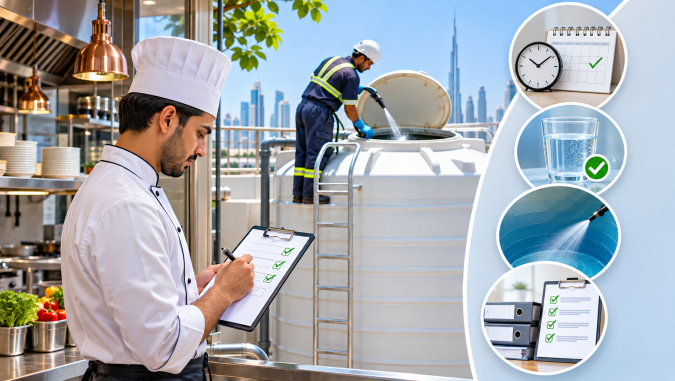
water tank cleaning for restaurants 18 September 26
Running a restaurant means working around a schedule that rarely leaves much room for disruption. Deliveries arrive, food preparation starts early, staff shifts change, and the kitchen may continue operating well into the night. A task such as water tank cleaning can therefore become difficult to arrange if it is treated as an ordinary maintenance job.
The solution is not to postpone the cleaning. It is to plan it around the kitchen.
Water stored in a tank can be used for food preparation, cleaning, washing equipment and other essential restaurant activities. Dubai Municipality's food safety guidance recognises water as an important part of food safety and requires food establishments to maintain appropriate controls over their water supply and storage.
With the right schedule, restaurant managers can complete tank cleaning with much less disruption to service.
Why Water Tank Cleaning Needs Careful Planning in Restaurants
A restaurant depends heavily on a reliable water supply. Even a short interruption can affect several parts of the operation at the same time.
Kitchen staff may need water for washing vegetables, cleaning preparation surfaces, washing utensils, operating dishwashers and maintaining general hygiene. Toilets, handwashing facilities and other areas may also depend on the same stored supply.
This is why simply choosing a convenient date for water tank cleaning for restaurants is not enough.
The timing should consider:
- Restaurant opening and closing hours
- Food preparation schedules
- Peak lunch and dinner periods
- Staff availability
- Cleaning and maintenance activities
- Water requirements for dishwashing
- Deliveries and stock preparation
- Building or mall management requirements
- Availability of an alternative water supply, where applicable
Dubai Municipality's Food Code states that food establishments should have an adequate supply of potable water for food preparation and cleaning. It also requires water storage tanks to be maintained clean, and cleaning and disinfection to be carried out periodically by an approved water tank cleaning company.
When Should a Restaurant Schedule Water Tank Cleaning?
The best time depends on how the restaurant operates.
For many restaurants, a period after closing is easier than attempting the work during active kitchen hours. However, overnight cleaning is not automatically the best option. If technicians need several hours to drain, clean, disinfect and restore the system, the actual duration should be confirmed before scheduling.
A useful approach is to look at the restaurant's weekly operating pattern.
Check the restaurant's quietest period.
Start by identifying the hours when water demand is normally lowest. This could be late at night, early morning or a scheduled weekly closure.
Avoid choosing a time simply because the kitchen is technically closed. Consider what happens immediately before and after the cleaning.
For example, if food preparation starts at 6:00 AM, a cleaning job that finishes at 5:30 AM may leave very little time for checks and reopening the water supply.
Coordinate with building management.
Restaurants located inside malls, hotels, food courts or commercial buildings may share water storage systems or maintenance arrangements.
In such cases, the restaurant manager should confirm:
- Whether the tank is dedicated or shared
- Who controls access to the tank?
- Whether building management must approve the work
- Whether other tenants depend on the same tank
- Whether additional documentation is required
Dubai Municipality's Food Code specifically addresses situations where a storage tank is shared by several food establishments and notes that the establishment should be able to provide documented evidence that the tank has been cleaned as required.
How to Plan the Cleaning Without Disrupting Kitchen Operations
Once the cleaning window has been selected, work backwards from the planned completion time.
1. Confirm the scope of work
Before booking the service, ask what the cleaning includes.
A proper job may involve inspection, draining, removal of sediment or deposits, cleaning of internal surfaces, disinfection and other checks required for the particular tank and water system.
Do not assume that every provider follows the same process.
If the tank is difficult to access, has heavy sediment or is part of a larger building system, the job may require additional preparation.
2. Protect food and kitchen equipment
Water tank maintenance should be planned as part of the restaurant's wider hygiene procedure.
Before work begins, kitchen managers should make sure exposed food, ingredients and food-contact items are protected from dust, debris, cleaning materials and other contaminants.
The cleaning activity should also be separated from food preparation wherever practical.
This is particularly important when access to the tank requires technicians to move through areas close to food storage or preparation spaces.
3. Plan around food preparation
Avoid scheduling tank cleaning immediately before a major preparation period.
For example, a restaurant preparing large quantities of food for lunch should not schedule the work shortly before morning preparation begins. Even if the tank cleaning itself finishes on time, there may not be enough time to complete the necessary checks and restore normal operations.
A better approach is to create a maintenance window with some buffer time.
4. Inform the kitchen team
The maintenance schedule should be communicated to the chef, kitchen supervisor, cleaning team and operations manager.
Staff should know:
- When the water supply will be interrupted
- How long the interruption is expected to last
- Which activities should stop during the work?
- When water is expected to be restored
- Who will confirm that the system is ready for use?
This avoids the common problem of maintenance being completed while kitchen staff are still expecting normal water service.
What Happens During Restaurant Water Tank Cleaning?
The exact procedure depends on the tank, access conditions and service provider, but a professional cleaning process generally involves several stages.
Inspection and preparation
Technicians first assess the tank and surrounding system. They may check the tank interior, access points, fittings and visible signs of sediment or contamination.
The water supply is then isolated according to the planned procedure.
Draining the tank
The tank is emptied in a controlled manner. Restaurant management should already have planned for the interruption so that kitchen operations are not unexpectedly affected.
Any remaining water should be handled according to the applicable maintenance procedure.
Removal of sediment and deposits
Sediment, dirt and other deposits can collect at the bottom and on internal surfaces of a storage tank.
These deposits need to be physically removed rather than simply disinfected over.
Cleaning and disinfection
Internal surfaces are cleaned, followed by disinfection using suitable products and procedures.
Dubai Municipality maintains information on approved professional-use biocides and cleaning and disinfection companies, making it important for businesses to verify that the provider and products being used are appropriate for the work.
For a restaurant, this stage deserves particular attention because the stored water can ultimately support food preparation and cleaning activities.
Refill and final checks
After cleaning and disinfection, the system is restored according to the applicable procedure.
Where water testing is required or forms part of the restaurant's verification programme, the relevant samples and reports should be arranged.
Keep the Right Documents After Cleaning
Cleaning should not end when the technician leaves the premises.
Restaurant managers should maintain a clear record of the work completed. Depending on the property's requirements and service arrangement, this may include:
- Cleaning and disinfection report
- Service date
- Tank identification
- Contractor details
- Disinfection information
- Water analysis or laboratory report, where applicable
- Next scheduled maintenance date
- Relevant building management records
Dubai Municipality's Food Code calls for food establishments to maintain documented evidence relating to tank cleaning and disinfection, analysis reports and other relevant tank-maintenance documentation.
Keeping these records in one location makes routine maintenance easier and helps the restaurant respond when documentation is requested during inspections.
Create a Water Tank Cleaning Schedule
Instead of booking the service only when someone remembers that the tank is due, add it to the restaurant's preventive maintenance calendar.
A simple schedule can include:
| Tank inspection | Date and observations |
| Cleaning | Service date and contractor |
| Disinfection | Date and treatment details |
| Water testing | Sample date and result, where applicable |
| Documentation | Reports and certificates |
| Next service | Planned maintenance date |
| Building coordination | Approval or access details |
The actual cleaning frequency should follow the current requirements applicable to the restaurant and its water system, along with any additional frequency indicated by monitoring or site conditions. Published Dubai Municipality food-safety guidance requires periodic tank cleaning and allows for more frequent cleaning where monitoring indicates it is necessary.
Common Planning Mistakes Restaurants Should Avoid
Several avoidable mistakes can turn routine maintenance into an operational problem.
Scheduling during peak service: This can interrupt food preparation, cleaning and customer service.
Allowing no buffer time: If cleaning takes longer than expected, the restaurant may not be ready when staff arrive.
Ignoring shared tanks: In malls and multi-tenant buildings, the tank may serve more than one business.
Not informing the kitchen: Staff may continue working as if the water supply is available.
Failing to keep records: Missing documentation can make it difficult to demonstrate that maintenance was completed.
Choosing a contractor without checking requirements: Restaurant operators should confirm that the service provider meets the relevant Dubai Municipality requirements.
A Practical Handover Checklist for Restaurant Managers
Before closing the maintenance job, check the following:
- Cleaning date recorded
- Tank and access area inspected.
- Sediment and visible deposits removed.
- Cleaning and disinfection completed.
- Water supply restored
- Required testing arranged or completed
- Cleaning/disinfection documentation received
- Building management informed, where applicable.
- Kitchen team informed that normal operations can resume.
- Next maintenance date added to the calendar.
A restaurant's water tank should be treated as part of its food-safety and preventive-maintenance system, not as an isolated plumbing task. Dubai Municipality continues to conduct inspections of food establishments, including restaurants, as part of its food-safety oversight.
Plan Water Tank Cleaning Around Your Restaurant, Not Against It
The easiest way to manage water tank cleaning for restaurants is to make it part of the operational calendar from the beginning.
Choose a low-demand period, coordinate with building management, protect food and equipment, allow enough time for the complete process and keep the relevant documentation after the work is finished.
For restaurants in Dubai, working with a properly qualified and approved provider is also an important part of maintaining the water storage system in line with applicable requirements.
If you are arranging scheduled maintenance for a restaurant, water tank cleaning services in Dubai can be planned around your kitchen's operating hours to reduce unnecessary disruption. For larger food-service premises, commercial water tank cleaning can also be coordinated with building maintenance and other scheduled services.


