

Why Is Tap Water Brown or Yellow in Dubai? Tank, Pipeline & Supply Causes
brown or yellow tap water in Dubai 04 September 26
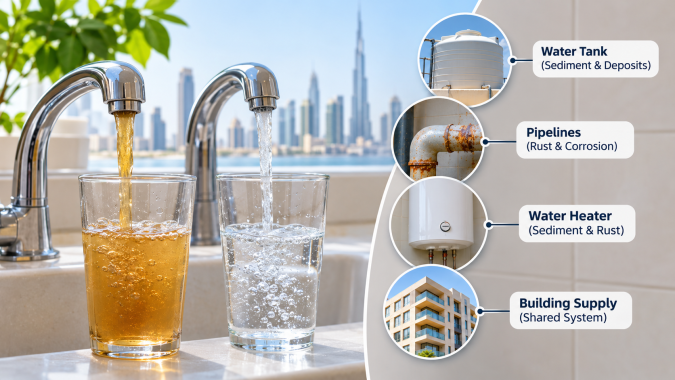
Seeing brown or yellow water come out of a tap can be unsettling, especially when the water normally looks completely clear. In Dubai, discoloured tap water does not necessarily mean the problem is with the municipal water supply. The source can be much closer to home, such as a storage tank, internal plumbing, water heater or another part of the building's water system.
The useful thing is that where and when the discoloration appears can provide clues about its source.
For example, water that looks brown from every tap may point to a shared storage or plumbing issue, while discoloration from only one faucet may be more localized. If only hot water is affected, the water heater deserves attention.
Understanding these differences can help property owners and tenants decide what to check rather than immediately assuming the entire water supply is contaminated.
What Causes Brown or Yellow Tap Water in Dubai?
Brown or yellow water is commonly associated with rust, sediment, mineral deposits or material that has accumulated somewhere within the property's water system.
Several possible sources should be considered:
- Water storage tanks
- Internal building pipelines
- Water heaters
- Individual plumbing fixtures
- Building-level water systems
- Temporary disturbance in the incoming supply
DEWA has advised customers to inspect internal water connections and notes that responsibility for internal connections lies with the customer after the meter.
That distinction is useful when trying to locate the source of a water-quality problem.
1. Sediment or Rust Inside the Water Tank
A storage tank can gradually collect sediment and other deposits if it is not properly maintained. Dust, particles and mineral material can settle at the bottom, while corrosion from fittings or connected components can introduce rust into the stored water.
When this material becomes disturbed, some of it can enter the distribution line and eventually reach household taps.
This is one reason a property may have clear water for weeks and then suddenly experience brown or yellow water.
Regular tank inspection and cleaning are therefore important parts of maintaining the building's water system. Dubai's public-health requirements include obligations relating to water systems and tanks, including ongoing cleaning and disinfection.
If discoloration is occurring throughout the property, the storage tank should be one of the first areas investigated.
For property owners and facility managers, professional water tank cleaning services in Dubai can help remove accumulated sediment and address tank hygiene as part of a wider maintenance routine.
2. Corroded or Aging Internal Pipelines
The water can also become discoloured after leaving the tank.
Older internal pipes, fittings and connections may develop corrosion over time. When water remains stationary for several hours, rust or sediment can collect inside the pipe. Once the tap is opened, the disturbed material can make the first flow appear yellow, orange or brown.
This can sometimes explain why water looks discoloured first thing in the morning or after a property has been unoccupied for a period.
If only one bathroom, kitchen tap or section of the property is affected, the problem may be more localized rather than coming from the main storage tank.
A plumber or qualified maintenance professional can inspect the affected pipework and fittings to determine whether replacement, flushing or another repair is necessary.
3. A Rusting Water Heater Can Affect Hot Water
There is another simple test that can help narrow down the source: compare the hot and cold water.
If the cold water is clear but the hot water appears yellow or brown, the water heater becomes a more likely suspect.
Sediment can accumulate inside water heaters, while internal components may corrode over time. In this situation, cleaning the main storage tank alone may not solve the problem because the discoloration is being introduced further along the system.
Try running both taps separately and compare the colour.
- Cold and hot water are both discoloured: investigate the tank, shared plumbing or incoming supply.
- Only hot water is discoloured: inspect the water heater.
- Only one tap is affected: check the local pipework, faucet or fitting.
This simple comparison can save time before arranging an inspection.
4. Could the Building's Water Supply Be Responsible?
Sometimes the issue may not originate inside an individual apartment or villa.
If several apartments, floors or properties experience discoloured water at approximately the same time, the problem could be connected to a shared building system.
For example, maintenance work, changes in flow or disturbance within a building's water infrastructure can sometimes move settled material through the system.
This is why it is useful to ask neighbours or the building management team whether they are experiencing the same problem.
DEWA's published guidance distinguishes between its water infrastructure up to the meter and internal connections maintained by the customer.
So, if the problem appears only after water has entered the property or building system, the investigation should extend beyond the municipal supply itself.
How to Tell Whether the Tank, Pipeline or Supply Is the Problem
Rather than guessing, look at the pattern.
| Brown water from several taps | Tank or shared building plumbing |
| Brown water from only one tap | Local pipe, fitting or faucet |
| Only hot water is brown | Water heater |
| Water is brown after standing overnight | Sediment or corrosion in internal plumbing |
| Several apartments have the same issue | Shared building system or supply-related disturbance |
| Water improves after flushing | Settled sediment may have been disturbed |
| Problem continues after flushing | Further inspection may be required |
This is not a substitute for professional water testing or plumbing inspection, but it can help identify where to start.
What Should You Do If Your Tap Water Turns Brown or Yellow?
The first step is to avoid assuming that the tank is automatically responsible.
Instead, work through a few basic checks.
Check Different Taps
Run the kitchen, bathroom and other taps separately. Note whether the colour appears everywhere or only in one location.
Compare Hot and Cold Water
This is particularly useful if you suspect the water heater.
Ask Other Residents
If you live in an apartment or managed building, ask whether neighbours are seeing the same discoloration. A building-wide problem should be reported to property management.
Let the Cold Water Run Briefly
If the water clears quickly, the initial discoloration may be related to settled material within the local plumbing. If it remains discoloured, further investigation is advisable.
Inspect the Water Tank
If multiple outlets are affected, the storage tank and connected plumbing should be checked for sediment, deposits, damaged covers, corrosion or other maintenance issues.
If the tank is due for maintenance, water tank cleaning and disinfection in Dubai should be carried out as part of a proper maintenance process rather than simply flushing the visible sediment away.
Why Cleaning the Tank May Not Always Solve Brown Water
One common mistake is assuming that tank cleaning automatically fixes every water-discoloration problem.
It may not.
If the storage tank is clean but an old pipeline continues releasing rust, the water can become discoloured again after leaving the tank. Likewise, if only hot water is affected, the water heater may need separate attention.
There can also be a combination of problems.
For example, sediment may accumulate inside the tank while corrosion exists in older internal pipework. Cleaning only one component could therefore provide a temporary improvement without addressing the underlying cause.
This is why identifying where the discoloration starts is more useful than simply treating the visible symptom.
When Should You Consider Water Testing?
Colour alone cannot tell you everything about water quality.
Brown or yellow water may indicate sediment or corrosion, but visual appearance does not identify every possible contaminant. If the discoloration continues, returns frequently or is accompanied by an unusual smell or taste, consider having the water system professionally inspected and, where appropriate, the water tested.
For commercial properties, residential buildings and other premises where water quality is particularly important, maintaining records of tank cleaning, disinfection and inspections can also help with ongoing facility management.
Dubai's current public-health framework specifically includes water systems and tanks within built-environment health requirements.
Final Takeaway
Brown or yellow tap water in Dubai does not have one single cause.
The source could be sediment inside a water tank, corrosion in internal pipelines, a problem with a water heater, a local plumbing fitting or an issue affecting a wider building water system.
The pattern of the discoloration provides an important clue. Check whether the problem affects one tap or several, compare hot and cold water, ask whether neighbouring properties are affected and inspect the storage system when necessary.
If the problem appears to be coming from the storage tank, proper cleaning and disinfection should be part of the solution. If the tank is clean but the water remains discoloured, the investigation should move further along the plumbing system rather than repeatedly cleaning the same tank.
A systematic approach can help property owners identify the likely source and decide whether they need tank maintenance, plumbing inspection, water-heater servicing or water testing.


